If your skin has started behaving differently — drier than it used to be, more reactive, breaking out when it never did before, or suddenly looking less firm — and you are anywhere between your late thirties and early fifties, perimenopause is very likely the reason.
These are not random changes. They are predictable, biological, and directly tied to shifting hormone levels. Understanding what is actually happening in your skin during perimenopause is the first step to responding to it correctly — rather than chasing symptoms with products that were built for a different version of your skin.
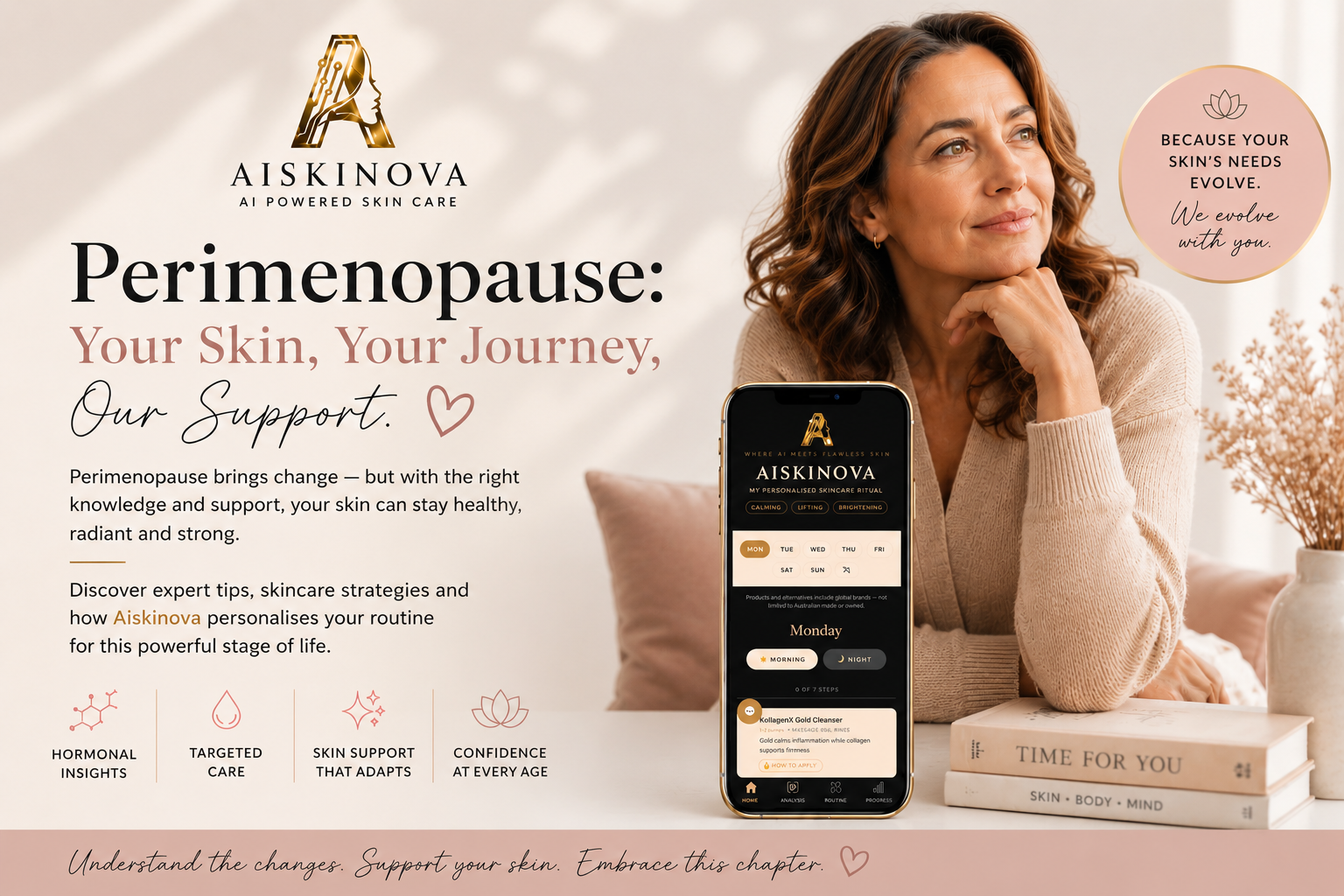
The Biology
What Is Perimenopause?
Perimenopause is the transitional phase leading up to menopause — the point when menstruation has stopped for twelve consecutive months. It typically begins in the mid-to-late forties, though it can start as early as the late thirties for some women. It can last anywhere from two to ten years.
During this time, oestrogen and progesterone levels fluctuate unpredictably before gradually declining. It is not a steady, gradual drop — it is erratic. Levels spike and fall without a consistent pattern, and it is this hormonal instability, more than the decline itself, that drives many of the skin symptoms women notice first.
The Oestrogen-Skin Connection
Oestrogen is the hormone most directly responsible for the health and behaviour of your skin across your lifetime. Its effects on skin biology are significant and wide-ranging:
- Oestrogen stimulates collagen synthesis — accounting for up to 30% of collagen production in the skin. When oestrogen declines, collagen production slows noticeably and skin loses the structural density that keeps it firm and plump.
- Oestrogen supports the skin barrier by promoting ceramide production — the lipids that hold skin cells together and lock moisture in. Lower oestrogen means a compromised barrier, and compromised barriers mean water loss, sensitivity, and reactivity.
- Oestrogen regulates sebum production. As levels fall, sebaceous gland activity decreases, and skin that was previously balanced or slightly oily can become significantly drier.
- Oestrogen promotes cell turnover. As it declines, the rate at which your skin renews itself slows — leading to a duller complexion, uneven texture, and slower wound healing.
- Oestrogen influences pigmentation by moderating melanin production. The hormonal shifts of perimenopause can trigger melasma or worsen existing sun damage.
The Changes
The Specific Skin Changes — And Why They Happen
Dryness and Dehydration
This is the most universally reported perimenopausal skin change. It has two distinct causes that are often confused: true dryness (lack of oil, driven by reduced sebum production) and dehydration (lack of water, driven by barrier dysfunction). Many perimenopausal women experience both simultaneously. Products that worked for years — a lightweight moisturiser, a gel cleanser — may suddenly feel insufficient because the skin's fundamental needs have shifted.
Loss of Firmness and Elasticity
Studies show that skin loses approximately 30% of its collagen in the first five years following menopause, and this decline begins during perimenopause. Elastin production also slows. The result is skin that feels less resilient, shows lines more readily, and begins to lose definition around the jawline and eye area. This is structural change — it cannot be addressed with surface hydration alone.
Increased Sensitivity and Reactivity
A weakened skin barrier allows irritants, allergens, and environmental aggressors to penetrate more easily. Skin that tolerated strong actives — AHAs, vitamin C, retinol — may suddenly become reactive to them. Redness, flushing, and a general sense of skin that is easily disturbed are common. This is not a permanent sensitivity — it is a barrier issue that can be managed — but it requires adjusting the approach to actives significantly.
Hormonal Breakouts
As oestrogen declines, androgens (male hormones present in all women) become relatively more dominant. This androgen shift can trigger acne in women who have never had it, or cause it to return after decades. Perimenopausal acne typically presents along the jawline and chin — the hormonal acne zone — and does not always respond to the same treatments that worked in adolescence.
Pigmentation Changes
Oestrogen normally moderates melanin production. When levels fluctuate, melanocytes (pigment-producing cells) can become irregular — producing patches of hyperpigmentation or making existing sun damage more visible. UV exposure accelerates this significantly, which is why SPF becomes non-negotiable at this life stage.
Thinning Skin
The dermis — the structural layer beneath the surface — becomes thinner as collagen and elastin decline. Perimenopausal skin can begin to look more translucent, bruise more easily, and feel more fragile. Thinner skin is also more vulnerable to UV damage and environmental stress.
The Solution
What Your Skincare Routine Needs to Change
The core shift in perimenopausal skincare is moving from maintenance to active support. The skin is no longer self-regulating as efficiently as it once did — it needs targeted help with barrier function, hydration, collagen stimulation, and pigmentation management simultaneously.
Barrier Repair First
Before introducing actives, the barrier needs to be stable. Ceramide-rich moisturisers, gentle non-stripping cleansers, and humectants like hyaluronic acid and glycerin are the foundation. If your skin is reactive, do not introduce multiple new actives at once.
Retinoids — Carefully
Retinol and prescription retinoids are the most evidence-backed ingredients for collagen stimulation and cell turnover. They are highly relevant for perimenopausal skin — but the increased sensitivity at this life stage means starting low, applying infrequently (two to three nights per week), and always buffering with moisturiser. Bakuchiol is a plant-derived alternative with retinol-like activity and significantly better tolerance for reactive skin.
Vitamin C for Pigmentation
A stable vitamin C serum helps regulate melanin production and supports collagen synthesis. Apply in the morning, always followed by SPF. Look for L-ascorbic acid at 10–15% concentration, or a more stable derivative (ascorbyl glucoside, sodium ascorbyl phosphate) if your skin is sensitive.
SPF Every Day — Non-Negotiable
Oestrogen decline makes skin more vulnerable to UV-triggered pigmentation and collagen breakdown. SPF 50+ used consistently is the single most effective anti-ageing tool at this life stage — and the one most frequently underused. Reapply if you are outdoors for more than two hours.
Peptides for Structural Support
Signal peptides (palmitoyl pentapeptide, matrixyl) stimulate collagen and elastin production and are well tolerated even by reactive skin. They work more slowly than retinoids but without the associated irritation — and they can be used morning and night without sensitising the skin.
Scale Back on Harsh Actives
Strong exfoliating acids used frequently, high-concentration vitamin C, and multiple actives layered together are more likely to compromise a perimenopausal barrier than improve it. Less, used consistently, outperforms more.
AISKINOVA
How AISKINOVA Addresses Perimenopausal Skin
AISKINOVA has a dedicated perimenopause life stage mode built into the analysis engine. When a user selects perimenopause as their current skin journey, the entire scoring and recommendation system adjusts:
- The ingredient engine prioritises barrier-supporting and collagen-stimulating ingredients, and flags ingredients that increase sensitivity risk
- Product recommendations weight heavily toward ceramide-rich formulations, gentle actives, and SPF
- Retinoids are recommended at appropriate frequencies rather than excluded — the system understands perimenopausal skin benefits from them when introduced correctly
- Hormone-disrupting ingredients including fragrance and certain preservatives are flagged in the product scoring
- The routine structure accounts for the dual need of active treatment and barrier repair simultaneously
The AI skin analysis also detects the specific concerns most common at this life stage — hydration levels, texture changes, firmness, and pigmentation — and weights your results accordingly.
The Key Takeaway
Perimenopausal skin is not broken. It has changed — biologically and fundamentally — and the skincare routine that worked for years simply has not caught up yet. The right response is not to use more product, or stronger product, but to understand what the skin now actually needs and build a routine around that.
The women who navigate this transition most successfully are the ones who stop fighting their skin and start working with its new biology.