AISKINOVA is not built on a generic quiz or a simplified skin type selector. The platform's analysis engine is architected around two specific clinical frameworks developed by dermatologists: the Baumann Skin Type System and the Lancer Ethnicity Scale. Understanding these frameworks — and how AISKINOVA digitises them — explains why the routines it generates are meaningfully different from anything a generic skincare guide can produce.
Framework One
The Baumann System — What Your Skin Is
Dr Leslie Baumann, a Miami-based dermatologist and researcher, identified a fundamental problem with how skincare has always been sold: the categories are wrong. "Oily," "dry," "combination," and "sensitive" are so broad that they're almost meaningless — and self-reported skin typing, as Baumann herself documented, is notoriously unreliable. People misidentify their skin type more often than not.
Her solution was a system based on four independently measurable axes, each representing a biological spectrum. Your skin sits somewhere on all four simultaneously, giving you one of 16 possible Baumann Skin Types.
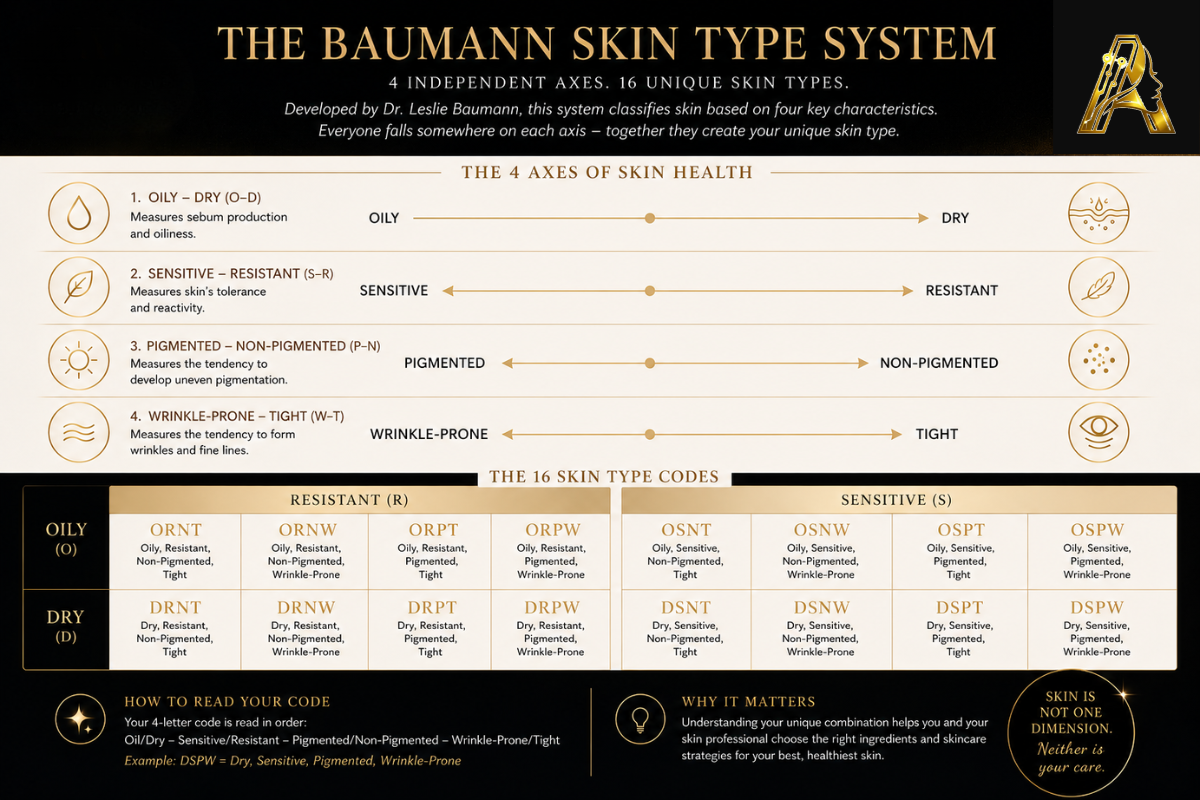
The Four Axes
- Oily vs Dry — sebum production, hydration retention, and moisture barrier integrity
- Sensitive vs Resistant — reactivity across four subtypes: acne, rosacea, contact sensitivity, and post-inflammatory pigmentation
- Pigmented vs Non-Pigmented — tendency to produce excess melanin in response to inflammation, UV exposure, or hormonal shifts
- Wrinkle-Prone vs Tight — structural factors including collagen density, sun history, and visible ageing markers
Skin Type Classification in AISKINOVA
Rather than asking users to self-identify, AISKINOVA performs AI micro-feature mapping from a face scan. The computer vision layer assesses hydration patterns, texture gradients, pore distribution, and redness zones — the same biological markers that underpin Baumann's four axes — and derives the classification objectively. This directly addresses the core weakness Baumann identified in her own original methodology: human self-reporting error.
Life Stage Modes
Baumann established that skin type is not static — it shifts with age, hormones, environment, and health events. AISKINOVA operationalises this through seven life stage modes: General, Pregnancy, Postpartum, Perimenopause, Menopause, Hormonal Acne, and Sensitive. A user who is DRNT (Dry, Resistant, Non-Pigmented, Tight) under baseline conditions may shift to a different effective type during perimenopause as oestrogen decline affects sebum production, moisture retention, and barrier function. AISKINOVA re-calibrates across all four axes when a life stage is selected.
Ingredient Intelligence Engine
Baumann's clinical recommendation is that ingredients be matched to the specific typed skin profile — not to a broad category. AISKINOVA's Ingredient Intelligence Engine implements this directly: every product in a generated routine is assessed for compatibility, ingredient conflicts, active concentration appropriateness, and life-stage safety before it is included. A retinoid that is correct for a wrinkle-prone, resistant skin type is automatically removed for any user in pregnancy or postpartum mode, regardless of their Baumann classification.
Where a traditional skincare quiz asks "is your skin oily or dry?", AISKINOVA's computer vision assesses hydration patterns, pore distribution, and texture gradients simultaneously — producing an objective classification across all four Baumann axes without relying on the user's self-perception.
Framework Two
The Lancer System — How Your Skin Tone Shapes Treatment
Dr Harold Lancer, Beverly Hills dermatologist to some of the world's most prominent clients, pioneered the clinical principle that skin tone is not an aesthetic variable — it is a biological one that fundamentally changes how skin responds to actives, UV exposure, procedures, and even routine sequencing. His Ethnicity Scale formalised this, establishing that melanin-rich skin requires meaningfully different protocols to prevent adverse outcomes, particularly post-inflammatory hyperpigmentation.
AISKINOVA implements the Lancer principles across three distinct layers of its analysis.
Monk Skin Tone Scale — MST-1 to MST-10
AISKINOVA maps every user to the full Monk Skin Tone Scale — ten tones from Porcelain (MST-1) to Ebony (MST-10) — with simultaneous undertone analysis (cool, neutral, warm) and reflectivity mapping. This is the modern, research-validated evolution of what Lancer pioneered with his Ethnicity Scale. The MST classification directly shapes product and shade recommendations in both the skincare and Get the Look colour-matching features, ensuring that recommendations are formulated for the user's actual melanin density — not for a hypothetical "average" skin tone.
Fitzpatrick UV Sensitivity Layer
AISKINOVA explicitly incorporates the Fitzpatrick Phototype Scale to assess UV reactivity, sun-exposure tolerance, and pigmentation response risk. This is central to Lancer's clinical approach: deeper skin tones (Fitzpatrick IV–VI) have different SPF requirements, different risks from chemical vs mineral UV filters, and a significantly higher susceptibility to post-inflammatory hyperpigmentation following exfoliant use or active ingredient introduction. AISKINOVA adjusts SPF recommendations, exfoliant concentration thresholds, and active introduction sequencing based on each user's Fitzpatrick classification.
Routine Sequencing and Pigmentation Risk Adjustment
A core Lancer principle is that the sequence of skincare steps matters as much as the products themselves — and that this sequence must be calibrated to the user's tone and sensitivity profile. AISKINOVA's AM/PM routine output specifies application order, timing between actives, and UV-sensitivity adjustments that reflect this philosophy. For melanin-rich skin tones, the system applies additional pigmentation risk adjustments: vitamin C is prioritised, niacinamide is included at appropriate concentrations, and exfoliants are introduced conservatively to minimise PIH risk.
A routine that is safe and effective for an MST-2 user with Fitzpatrick Type I skin may cause post-inflammatory hyperpigmentation in an MST-8 user with Fitzpatrick Type V skin — even if both users have identical Baumann types. The Lancer layer is what prevents AISKINOVA from producing the same routine for biologically different skin.
Both Systems Together
The two frameworks address different dimensions of the same problem. Baumann answers the question of what your skin biologically is. Lancer answers the question of how your skin tone and UV sensitivity should shape every treatment and protocol decision.
| Framework | Where it lives in AISKINOVA |
|---|---|
| Baumann | AI micro-feature mapping, skin type classification across four axes, Ingredient Intelligence Engine, seven life stage modes |
| Lancer | Monk Skin Tone Scale (MST-1 to MST-10), Fitzpatrick UV sensitivity layer, routine sequencing, pigmentation risk adjustment |
AISKINOVA essentially digitises both systems simultaneously — using Baumann to determine what your skin is, and Lancer to determine how your skin tone and sensitivity should shape every treatment and product protocol that follows. The result is a routine built on the same clinical logic a dermatologist would apply — delivered in two minutes, free, from your phone.
See Both Systems Applied to Your Skin
AISKINOVA's analysis takes under two minutes and maps your skin across both the Baumann and Lancer frameworks simultaneously — free, no account required.
Start Free Analysis →